Simultaneous interpretation
Simultaneous interpretation is a type of spoken interpretation in which the speaker's words are translated almost at the same time, with a delay of only a few seconds. Listeners hear the talk in their own language, and the speaker never stops to wait for the interpreter. Simultaneous interpretation is used at conferences, product launches, church services and any event where the speaker and the audience speak different languages.
In this guide we explain how simultaneous interpretation works, what a simultaneous interpreter does, what equipment is needed, and how AI simultaneous interpretation is changing the way events are organized in Armenia.
What simultaneous interpretation is
"Simultaneous" means "at the same time". You will also see the service called simultaneous interpreting, live interpretation or real-time translation. All of these names mean the same thing: the interpretation runs in parallel with the speech.
In the classic setup, a simultaneous interpreter sits in a soundproof booth, listens to the speaker through headphones and interprets into a microphone straight away. Guests hear the interpretation through receivers and headsets, choosing the channel for their language. Today there is a second option as well: AI simultaneous interpretation, where the interpretation reaches guests' phones. We cover both below.
Simultaneous vs consecutive interpretation: what's the difference
There are two main types of spoken interpretation: simultaneous and consecutive. In consecutive interpretation the speaker says a few sentences, pauses, and the interpreter repeats what was said in the other language.
| Criterion | Simultaneous interpretation | Consecutive interpretation |
|---|---|---|
| How it works | The interpretation runs in parallel with the speech | The speaker pauses, the interpreter repeats |
| Length of the talk | Unchanged | Roughly doubles |
| Number of languages | Several languages at once | Usually one language |
| Equipment | Booth and receivers, or guests' phones | A microphone is enough |
| Best for | Conferences, services, large audiences | Negotiations, interviews, small meetings |
A simple example: a 40-minute talk takes about 80 minutes with consecutive interpretation, but stays at 40 minutes with simultaneous interpretation. That is why large events almost always choose simultaneous interpretation.
Who a simultaneous interpreter is
A simultaneous interpreter is a spoken-language interpreter who can listen, understand, translate and speak all at once. It is one of the hardest kinds of translation work, because the interpreter cannot wait for the end of the sentence and has to anticipate where the speaker's thought is going.
A good simultaneous interpreter needs:
- Excellent command of both languages. Not just vocabulary, but expressions, idioms and cultural context.
- Preparation on the topic. The interpreter studies the topic, terminology, names and slides in advance.
- Focus and stamina. Attention drops after about half an hour of continuous work, so at long events simultaneous interpreters work in pairs and take turns.
- A clear voice and diction. Guests hear the interpretation through a headset, and slow or unclear speech quickly becomes tiring.
There are not many experienced simultaneous interpreters in Armenia, especially for specialized topics. That is why they are usually booked weeks in advance.
What classic simultaneous interpretation requires
Classic simultaneous interpretation is more than the interpreter. You usually need:
- An interpreter booth, so the interpreter's voice does not disturb the hall.
- An interpreter console and microphone.
- A transmitter that sends the interpretation into the hall.
- A receiver and headset for every guest.
- A technician who sets up the equipment and hands out and collects the receivers.
Every additional language means another interpreter (or pair) and another channel. You will find a detailed cost breakdown in our article The cost of simultaneous interpretation in Armenia. To learn what an equipment set includes and what to check before renting, read Simultaneous interpretation equipment.
AI simultaneous interpreter: how it works
In recent years a new option has appeared: simultaneous interpretation powered by artificial intelligence. Verba is such a solution for events in Armenia. It works in four simple steps:
- The speaker talks into a microphone. The organizer opens the speaker page on a laptop or tablet and connects a microphone or the hall's sound system.
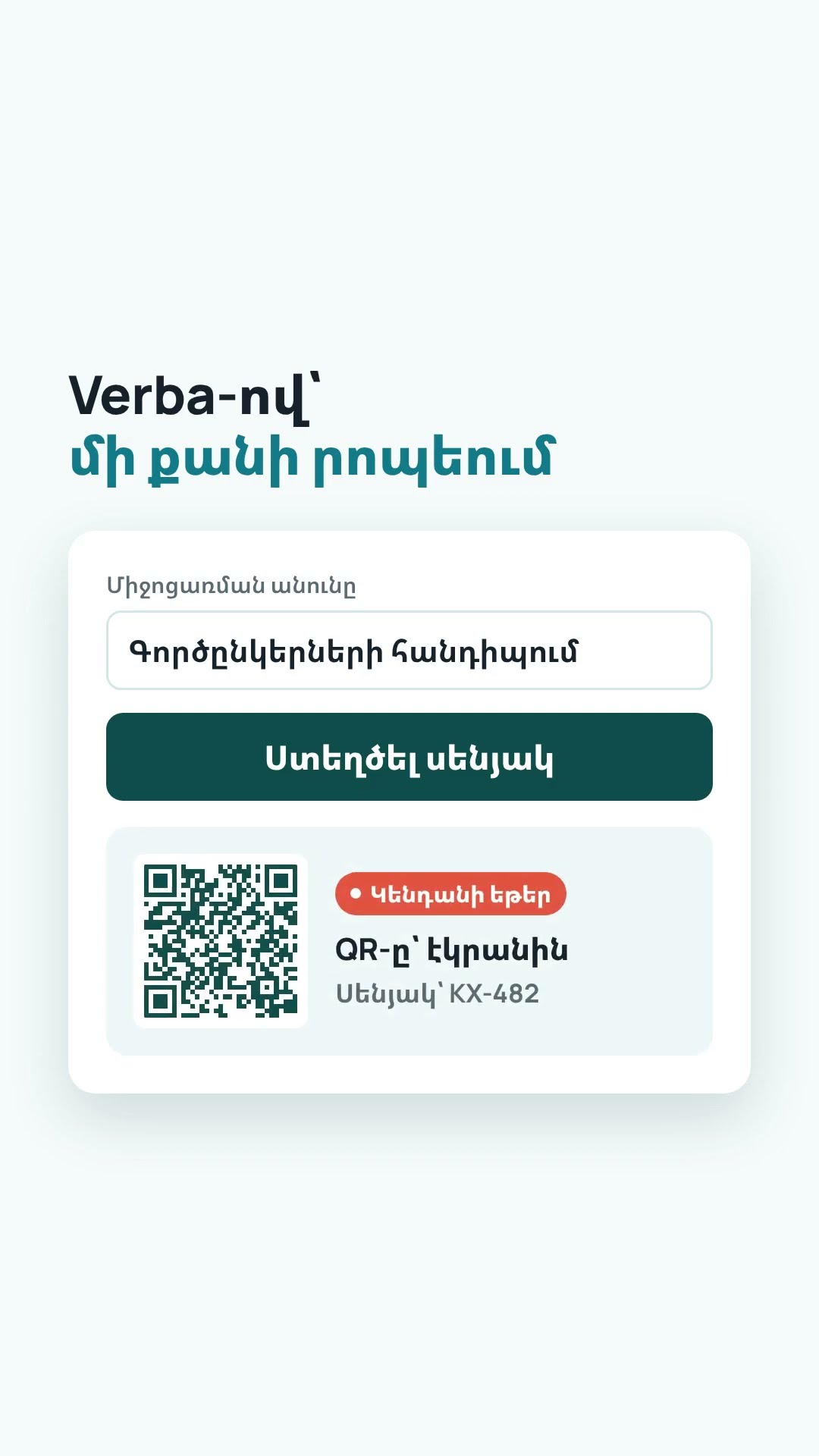
- Guests scan a QR code. The code is shown on the screen or printed on the tables. No app to download and no sign-up.
- Each guest picks their language. Armenian, English or Russian. Guests in the same hall can listen in different languages.
- The interpretation reaches the phone as voice and text. A guest can listen to the translated voice through headphones, read the live text on the screen, or both.
Today the speaker in Verba speaks English, and guests choose Armenian, English or Russian. No booth, receivers or technician are needed, because guests use their own phones and headphones.
Human or AI simultaneous interpreter: a comparison
| Criterion | Human simultaneous interpreter | AI simultaneous interpreter (Verba) |
|---|---|---|
| Price | About 50,000 AMD per hour + 25–30,000 AMD for equipment | 15,000 AMD per hour |
| Extra language | A new interpreter and a new channel | Included in the same price |
| Equipment | Booth, receivers, headsets | Guests' phones |
| What the guest gets | Voice only | Voice and live text |
| Delay | A few seconds | A few seconds |
| Nuance and rare terms | More accurate if the interpreter has prepared | Can make mistakes with names and rare terms |
| Booking | Weeks in advance | Any time |
The honest answer is this: AI does not replace a human interpreter in every situation. For legal, medical and diplomatic events, where every word matters, we recommend a human simultaneous interpreter or at least a test run. For conferences, product launches, lectures, weddings and church services, AI simultaneous interpretation is a fast, affordable and sufficient option.
Where simultaneous interpretation is used
- Conferences and forums. International speakers and a multilingual audience with Armenian-, Russian- and English-speaking guests.
- Church services. Guest preachers from abroad and congregation members who prefer different languages. For regular services Verba has a plan for churches and communities: 60,000 AMD per month, up to 8 hours.
- Product launches and business events. Product presentations, partner meetings, trainings.
- Lectures and master classes. Universities and education programmes with foreign lecturers.
- Weddings and family events. When some of the guests are from the diaspora or another country.
Checklist: how to choose a simultaneous interpreter
- Work out how many languages you need and how many guests there will be.
- Ask whether the price is for one interpreter or a pair.
- Check whether equipment rental is included in the price.
- Ask for an example of previous work or a short trial.
- Share slides, names and key terms in advance.
- Hold a technical rehearsal before the event, in the same hall and with the same microphone.
- Have a backup plan for the internet, power and sound.
If you are organizing interpretation for the first time, read our step-by-step guide How to organize simultaneous interpretation for an event.
How much simultaneous interpretation costs
In Yerevan the average price of a human simultaneous interpreter is about 50,000 AMD per hour, plus 25–30,000 AMD for equipment rental. Long events need a pair of interpreters, and every new language nearly doubles the budget.
With Verba, AI simultaneous interpretation costs 15,000 AMD per hour, in three languages, with voice and text. A 10-hour package costs 120,000 AMD and a 25-hour package 250,000 AMD; both are valid for 12 months. For events with more than 300 listeners we prepare a custom quote. The detailed calculation is here.
Summary
Simultaneous interpretation lets the speaker and the audience understand each other without interrupting the talk. A human simultaneous interpreter is the best choice for events where every word matters. An AI simultaneous interpreter is several times more affordable, works without equipment and delivers both voice and text in several languages at once.
Want to see how it works? Create a room and try the first 30 minutes for free, or book a free demo for your event.